

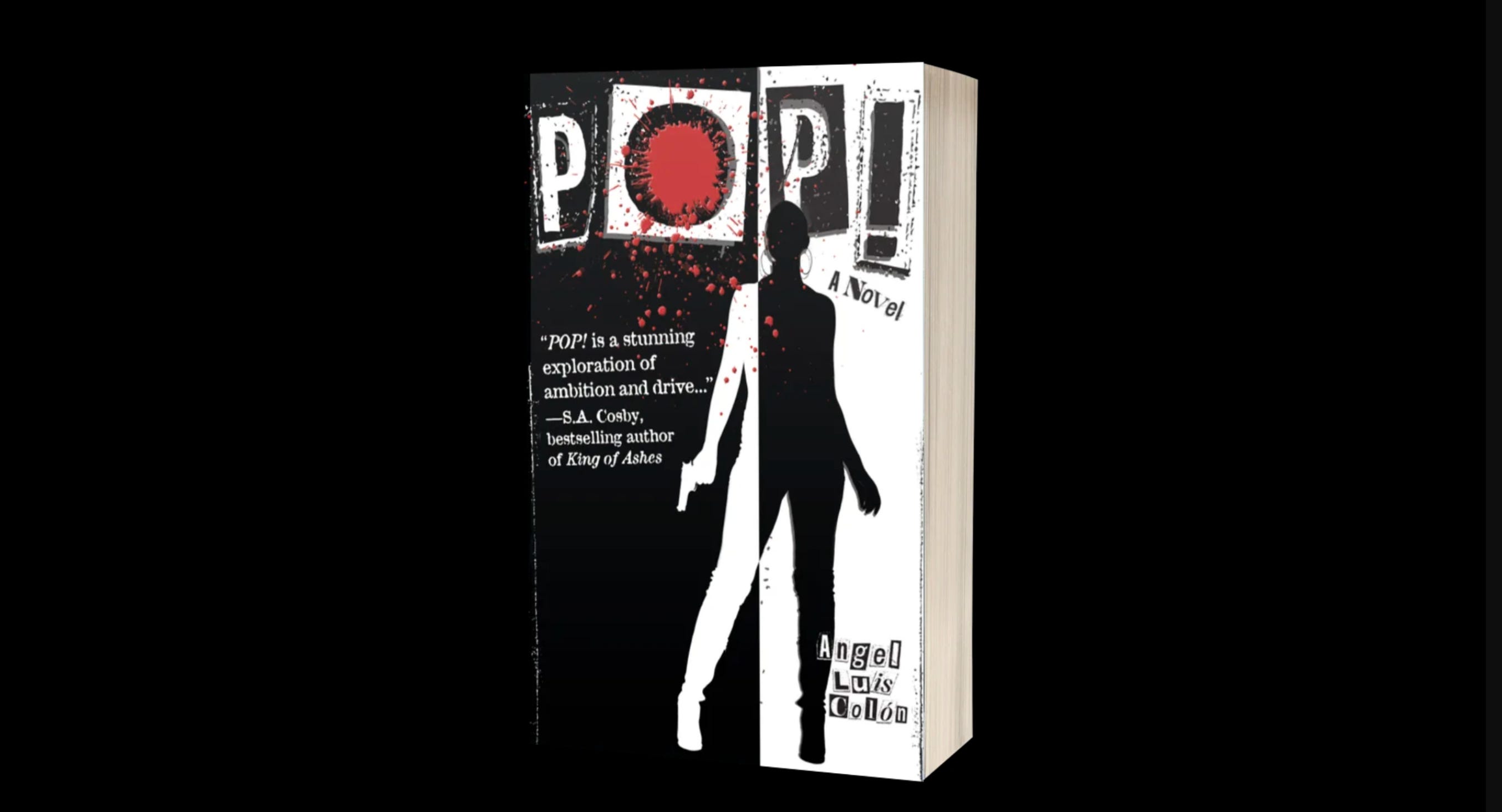
First things first: Angel Luis Colón’s “POP!”, which came out this week via Ruadán Books, is easily the funniest crime novel of the year, and maybe one of the most bitter outside of Jordan Harper’s “A Violent Masterpiece.” It follows Poppy Leathers, who burns way too much of her time and energy (and considerable smarts) working on behalf of thoroughly mediocre men, including an assassin wracked by ennui and a pretentiously unoriginal artist. There’s heavy subtext here about the failures of capitalism, gentrification, and “meritocracy,” but that doesn’t slow down the book’s blistering pace. It’s a kick.
Colón is one of those writers who keeps producing great work. I met him over a decade ago, when he was publishing his (also bleakly funny) Blacky Jaguar crime novellas with Shotgun Honey; he moved on to crime and YA novels, with a whole slew of short stories, comics, and other projects mixed in. I wanted to talk with him about the ideas behind “POP!”, what makes a great villain, and more.
Poppy is a perfect anti-hero…or should I say villain? You understand her motives perfectly, she’s a hard worker, and she has good taste. At the same time, she also does some pretty terrible things. When you’re designing a character like her, do you really care if they’re “likable,” or is it all about ensuring they’re well-rounded?
I’ve talked a million ears off about this and I will forever die on this hill – likeability doesn’t matter to me. I don’t believe in worrying about whether a character is relatable, likeable, whatever; I don’t care. What matters is a character having their convictions and motivations. They can be weird and awful, but if that is who they are meant to be, that is what they are meant to be. I find myself far more interested in how certain characters navigate stories and I’ve yet to find myself very engaged when said characters are as bland as vanilla ice milk.
Sloppy folks in sloppy situations will always be a lot more interesting.
I think the obsession with likeable characters leads into more concerning territory about media literacy and it makes me think of an old social post from a handle I can’t remember that I will terribly paraphrase: Folks can’t help but see depiction in popular media as an endorsement when their entire diet is escapist or validating. When they see media about uncomfortable topics, they assume others are consuming horrible things for pleasure and make judgement.
I’ll caveat that there is plenty of gutter slop being made that explicitly endorses horrible, horrible things and work like that isn’t art, so I’m excluding that in my argument.
One thread throughout your novels is the existentially distressed hitman; I’m thinking of your excellent “Hell Chose Me,” which came out several years ago, and features a hardcore portrait of a bad soul in torment. Atticus, your hitman in “POP!”, is ostensibly more comic, but with a deep undercurrent of pathos. What keeps drawing you back to this kind of character? How are they useful in terms of expressing your books’ bigger themes?
Sometimes we choose what we are experts at, but more often than not, we land into things that we become experts at (more often against our will). For something like a professional killer, there’s something there we don’t normally see in the real world – the conscious decision to lean into doing something deeply repugnant for money. Where does that come from?
In the case of “Hell Chose Me” I wanted to explore the tragedy of that kind of life and how misplaced ideas of masculinity were at the root of the problem. In POP! I decided to focus on what it would be like when a career as a professional killer becomes unfulfilling. There’s something horrifically comedic about the idea of a person so completely bored of murdering people that they begin to consider a career shift in mid-life.
I’d argue that while these are very different takes on hitmen, I still use these characters to explore a society that has utterly consumed itself in its pursuit of power and influence. Murder as an open business feels like a logical end point to where we’re at. I guess I want to understand it as well as I can before it destroys us all.
Speaking as someone who spent perhaps too many years living in Park Slope and other Brooklyn enclaves, I thought you parodied the hipster ecosystem perfectly—not just the pretentious focus on artisanal products and “edgy” art, but also the streak of real cruelty and exclusion that runs beneath it. When you started putting together the ideas for “POP!”, what compelled you to take a railgun to hipsterdom?
That’s the Bronx in me. I come from one of the last ‘unconquered’ boroughs (that is very much becoming conquered), so seeing the world in which I came up becoming this shrink-wrapped fantasy version of NYC for people who were born elsewhere and will move on to succeed elsewhere, I wanted to focus on how absolutely cruel that process is to the people who built these communities.
Brooklyn, for me, was one of the first victims of gentrification I’d ever seen, so that struck a deep chord with me. Doubly so as someone of Puerto Rican ancestry – my people are some of the OGs of being underfoot to the colonizer mindset. These days, you really see the impact in the aftermath of gentrifiers fleeing out of the urban areas. It’s post-apocalyptic. They leave a place worse than how they “found” it.
Which makes setting the story of a criminal wanting to rule a criminal empire based in a place that’s so utterly doomed even more compelling to me. There’s a tragedy in Poppy’s ambitions and methods being so aligned with folks who undervalue her and I hope readers really pick up on that.
In addition to your crime fiction, you’ve written some books for young adults. There are some obvious differences between those genres — you can’t have bloody wall-to-wall violence in a YA novel, for starters — but I imagine some commonalities, as well. How do you approach composing a YA book vs. one aimed at adults?
Honestly? I don’t really approach either very differently. While I’ll tone down some aspects, more often crude language, a book like “Infested”, my YA horror novel, is probably as violent as anything I’ve written in the adult space. Now, if I’m writing Middle Grade, I massively tone things down, but I’ve found that doesn’t mean you write down – if that makes sense.
Readers are readers no matter the age, so I’ve learned they will understand what I’m conveying without ever talking down to them. If anything, the younger the reader, the more nuanced they can be when it comes to ingesting themes – especially social themes. I’ve often found myself having to be slightly more ham-fisted with adults, to be honest.
That said, I have found interiority is far more vital in the YA space. You really need to think about how your characters think and react in their own minds to the events unfolding around them. I focus on that with my adult work, but those moments are a little brisker than with YA. I like to think that has a lot to do with the fact that by the time we’re adults, we’re better at emotional management (I know there are exceptions0, so big feelings don’t leave us mulling over our decisions as often.
What’s on your wish list to write next?
If you were to ask my agent the answer is probably too much. The list is pretty damn long.
For one, I’m about to submit a new YA novel to editors. It’s a little fantasy and a little horror and very Puerto Rican. I’m excited to see the response to it, honestly.
I’m also working on a few errant ideas. I’m enjoying the low fantasy/horror stuff, but I have a few crime novel ideas I might jump back into; including a period piece that spans the 80s/90s in The Bronx. There’s also a PI novel that’s very much in the key of a Big Lebowski detective story.
I’ll also do incredibly degrading things to get my hands on Marvel’s White Tiger. First Latino superhero that’s Puerto Rican, but as far as I know, never written by a Puerto Rican? Hi, I’m right here. I will write that. I already have a full pitch.
Contact me, Marvel. I like money and upsetting nerds. We’re a match made in heaven.
Great review! Excited to pick this up. Also I forgot about Jordan Harper's new novel coming out this year and I totally missed it. Need to pick that up.
> I’ve talked a million ears off about this and I will forever die on this hill – likeability doesn’t matter to me. I don’t believe in worrying about whether a character is relatable, likeable, whatever; I don’t care. What matters is a character having their convictions and motivations. They can be weird and awful, but if that is who they are meant to be, that is what they are meant to be. I find myself far more interested in how certain characters navigate stories and I’ve yet to find myself very engaged when said characters are as bland as vanilla ice milk.
I read this and immediately thought of a book by Tana French I just read. The Witch Elm is told in first-person and the protagonist is actually very unlikable. But I loved the book and I was still rooting for him throughout the story, despite his many many flaws.
Great discussion here. Enjoyed it.